
Kerala Is Not Starting from Zero
The phrase “MedTech hub” can easily become a slogan. In Kerala's case, however, there is a measurable industrial base behind the ambition.
Invest Kerala reports that the state contributes 15% to India's medical device industry. Its Innovation in Health initiative also describes an ecosystem of 85 medical device companies generating more than ₹9,000 crore (USD 1.05 billion) in annual revenue. A separate Invest Kerala sector page refers to more than 70 medical device manufacturing units and highlights established companies operating from the state. The counts should not be treated as interchangeable—they may use different definitions or reporting periods—but together they indicate meaningful industrial activity rather than an ecosystem beginning from scratch.12
This matters because medical device clusters are built cumulatively. Existing manufacturers create experienced technical talent, suppliers, quality knowledge, regulatory familiarity, and practical understanding of international customer expectations. Successful products and technology transfers also make it easier for researchers, founders, investors, and institutions to see a credible path from an idea to a manufactured device.
Kerala can therefore approach the next phase from a position of proven capability. The objective is not simply to attract isolated projects. It is to deepen the relationships, services, infrastructure, and talent that allow a larger number of firms to innovate and scale reliably.
A Rare Research-to-Industry Foundation
One of Kerala's most important assets is the presence of the Sree Chitra Tirunal Institute for Medical Sciences and Technology (SCTIMST), an Institution of National Importance under the Government of India's Department of Science and Technology.
SCTIMST's medical-device work spans the lifecycle from conceptualisation and computer-aided modelling to fabrication, prototyping, functional evaluation, and technology transfer. Its published institutional material describes industry support capabilities and a record of transferring and commercialising products including heart valves, blood bags, oxygenators, dental and orthopaedic materials, diagnostic tools, and other medical technologies.34
That track record illustrates an essential feature of MedTech: invention alone is not enough. A device must be designed around a real need, evaluated systematically, supported by appropriate evidence, manufactured under controlled conditions, and prepared for the relevant regulatory and market pathway. Institutions that understand both research and translation can help close the distance between laboratory work and dependable products.
Kerala also has research, academic, startup, and healthcare institutions working across biotechnology, engineering, clinical care, digital technology, and entrepreneurship. The value lies not only in the number of institutions, but in whether they can work with industry through clear, repeatable pathways.
Connected Industrial Strengths Create an Advantage
Medical devices are multidisciplinary products. Depending on the device, they may combine polymers, rubber, precision components, electronics, sensors, software, biomaterials, packaging, sterilisation, and specialised manufacturing processes. This makes the surrounding industrial base particularly important.
Kerala's Industrial Policy 2023 identifies medical equipment as a priority sector. It also names several connected fields as priorities, including biotechnology and life sciences, electronic system design and manufacturing, engineering research and development, high value-added rubber products, artificial intelligence and robotics, design, and 3D printing.5
The overlap creates a practical opportunity:
- Kerala's rubber expertise can support gloves, catheters, tubing, seals, and other medical-grade products.
- Electronics and software capability can contribute to diagnostic, monitoring, active, connected, and software-enabled devices.
- Biotechnology and biomaterials research can support diagnostics, implants, regenerative applications, and combination products.
- Engineering R&D, design, and advanced fabrication can strengthen prototyping, tooling, test systems, and manufacturing automation.
These adjacencies do not automatically become a cluster. Medical applications require specialised standards, quality controls, materials knowledge, traceability, risk management, validation, and regulatory understanding. The opportunity is to help capable firms in related sectors cross that gap responsibly.
Common Infrastructure Can Change the Economics of Innovation
Medical device development can require facilities that are expensive and difficult for an early-stage company to build alone. Prototyping, pilot manufacturing, material characterisation, package validation, sterilisation, pre-clinical evaluation, and device testing can all create cost and scheduling barriers.
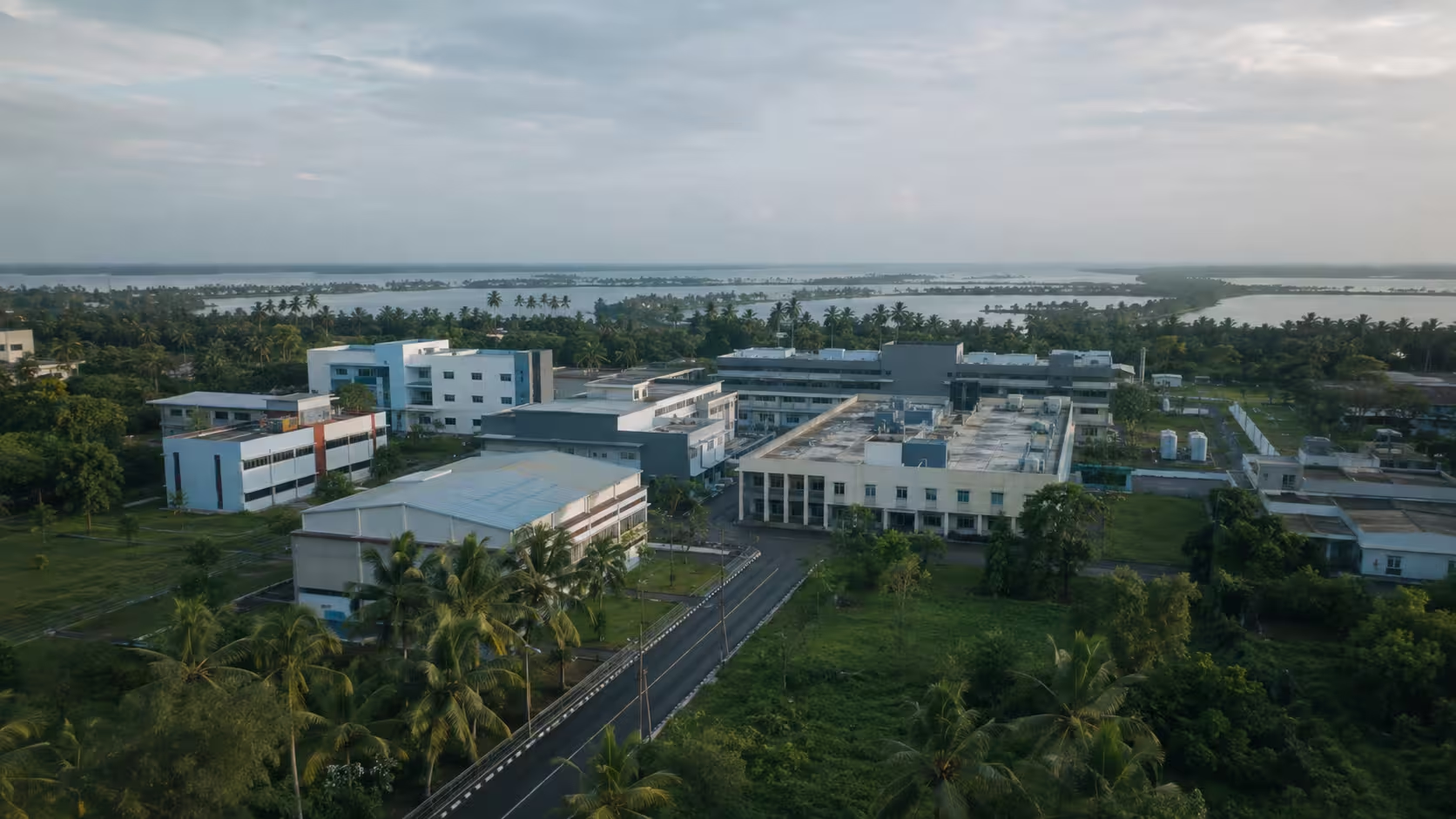
A Government of Kerala order dated 19 December 2024 describes MedSpark as a joint venture between SCTIMST and the Kerala State Industrial Development Corporation (KSIDC), being established on nine acres at the Life Sciences Park. The proposed components include a prototyping, pilot-manufacturing and incubation centre; a medical-device testing and evaluation centre; R&D and knowledge resources; and large-animal facilities for pre-clinical requirements.6
The principle is significant even while operational details continue to evolve. Shared facilities can reduce duplicated capital expenditure, improve access to specialist equipment and expertise, and help firms plan development more systematically. Their value, however, depends on more than buildings. Industry needs transparent access rules, competent staff, credible quality systems, predictable turnaround times, appropriate accreditation, and pricing that is workable for both startups and established manufacturers.
For public website copy, it is important to distinguish planned capability from operational capability. Facilities should be described as proposed, being established, commissioned, or operational only on the basis of a current official update.
The National Opportunity Is Large—and Demanding
Kerala's state-level opportunity sits within a wider Indian manufacturing challenge.
The Department of Pharmaceuticals' Annual Report 2025–26 describes India as one of the fastest-growing global medical device markets, expected to grow at a compound annual rate of 15%. It identifies India as Asia's fourth-largest medical device market and among the world's top 20.7
At the same time, the Department reported in March 2026 that imports constitute around 60% of domestic medical-device consumption. For FY 2024–25, category-wise imports were reported at USD 8.822 billion, with electro-medical equipment the largest category in the published table.8
The trade picture also shows growing outward potential. A Department of Commerce release in March 2026 stated that India's medical device exports crossed USD 4 billion in FY 2024–25.9
These figures point to two related opportunities:
- Develop reliable Indian products in categories where healthcare depends heavily on imports.
- Build companies capable of competing in international markets on quality, evidence, performance, service, and cost.
Neither outcome comes from low-cost manufacturing alone. Medical devices earn trust through lifecycle quality, clinical and performance evidence, regulatory discipline, supply reliability, and post-market responsibility.
Regulation and Quality Must Be Designed In
India's Medical Devices Rules use a risk-based framework, with devices classified from Class A (low risk) to Class D (high risk). The applicable pathway depends on the product, intended use, risk, and current rules and notifications.10
This has an important implication for ecosystem-building: regulatory thinking cannot be left until a prototype is “finished”. Intended use, classification, risk management, design controls, testing strategy, clinical/performance evidence, quality systems, supplier controls, documentation, and manufacturing processes influence one another.
The Bureau of Indian Standards' material on IS 23485 similarly emphasises quality management and essential principles of safety and performance across the lifecycle, including risk evaluation, clinical evaluation, biocompatibility, software validation, and other relevant controls.11
For Kerala to build a reputation as a trusted source of medical technology, quality cannot be treated as a compliance department's final checkpoint. It must become part of product strategy, engineering practice, supplier development, leadership decisions, and workforce training.
The Missing Layer Is Often Coordination
Kerala has manufacturers. It has researchers, engineers, clinicians, hospitals, startups, institutions, and public initiatives. Yet MedTech development can still stall when these capabilities are difficult to discover or engage.
A clinician may identify an important need but lack an engineering and commercial team. A startup may build a promising prototype but discover its testing and regulatory requirements too late. A manufacturer may have production experience but limited access to emerging research. A capable supplier from another sector may not understand medical-grade documentation and validation. An institution may offer specialised equipment but lack a clear industry access pathway.
The Kerala Medical Technology Consortium (KMTC), a Government of Kerala flagship initiative, explicitly describes the need to connect research, academia, industry, healthcare, startups, and government across the long medical-technology development lifecycle.12
An industry association has a distinct and complementary role. KMDIA can help aggregate the operating priorities of companies, identify common barriers, connect members with relevant resources, and create a consistent channel for industry dialogue.
What KMDIA Can Contribute
KMDIA's value will be measured by practical outcomes, not only by the size of its network. Useful areas of action include:
Build a credible evidence base
Maintain an up-to-date map of manufacturers, product segments, suppliers, service providers, skills, infrastructure needs, and market barriers. Better data leads to better policy and programme design.
Strengthen regulatory and quality capability
Organise expert-led learning, peer exchange, and official-source explainers that help companies ask the right questions early. KMDIA should inform and connect; it should not represent itself as a regulator or certification body.
Represent common infrastructure needs
Collect member evidence on gaps in testing, validation, sterilisation, tooling, pilot manufacturing, and other services. Constructive, specific industry input can help shared facilities align with real demand.
Connect innovation with manufacturing
Create structured ways for startups and research teams to meet experienced manufacturers, specialist suppliers, clinicians, and quality professionals.
Improve scheme and market awareness
Help members find relevant public schemes, calls, events, and trade opportunities while making clear that eligibility and selection remain with the responsible institution.
Support export readiness
Promote learning around target-market selection, regulatory planning, quality systems, documentation, distribution, service, and post-market capability—not simply participation in trade fairs.
What Success Would Look Like
A successful MedTech hub is not defined by a single park, event, policy, or flagship company. It is visible in the performance of the whole system:
- More clinical and research ideas progressing through responsible development.
- More startups surviving the transition from prototype to regulated product.
- More suppliers achieving medical-grade capability.
- Faster, more predictable access to credible testing and specialist services.
- Stronger quality and regulatory talent.
- Greater collaboration between institutions and manufacturers.
- More Kerala-made products earning adoption in India and abroad.
- An industry voice that is representative, evidence-led, and constructive.
From Potential to Performance
Kerala has a credible foundation for becoming one of India's leading MedTech ecosystems. It has an established industrial base, recognised research capability, connected priority sectors, skilled talent, and a policy environment that acknowledges the opportunity.
The decisive phase is now one of execution: connecting the ecosystem, embedding quality, building shared capability, listening to clinical needs, strengthening manufacturers and suppliers, and helping enterprises compete beyond the state.
KMDIA's vision is deliberately ambitious. Realising it will require patient, coordinated work across industry, institutions, healthcare, government, and markets. That collective effort is precisely why an industry association matters.
References
-
Invest Kerala, “Innovation in Health”: https://investkerala2025.kerala.gov.in/innovation-in-health/ ↩
-
Invest Kerala, “Medical Equipments”: https://www.invest.kerala.gov.in/doing-business-in-kerala/thriving-sectors/medical-equipments/ ↩
-
SCTIMST, Department of Medical Devices Engineering: https://new1.sctimst.ac.in/about-sctimst/organisation/biomedical-technology-wing/department-of-medical-devices-engineering/ ↩
-
SCTIMST institutional website: https://sctimst.ac.in/ ↩
-
Government of Kerala, Kerala Industrial Policy 2023: https://industry.kerala.gov.in/images/pdf/2023/IND_POLICY_ENG.pdf ↩
-
Government of Kerala, G.O.(Rt) No.1192/2024/ID, 19 December 2024: https://document.kerala.gov.in/documents/governmentorders/govtorder2012202417%3A52%3A29.pdf ↩
-
Department of Pharmaceuticals, Annual Report 2025–26: https://pharma-dept.gov.in/sites/default/files/Annual%20Report%202025-26.pdf ↩
-
Press Information Bureau / Department of Pharmaceuticals, “Medical device park”, 17 March 2026: https://www.pib.gov.in/PressReleasePage.aspx?PRID=2241167&lang=1®=3 ↩
-
Press Information Bureau / Department of Commerce, medical device export ecosystem release, 14 March 2026: https://www.pib.gov.in/PressReleasePage.aspx?PRID=2240258&lang=2®=48 ↩
-
CDSCO, Medical Device & Diagnostics: https://www.cdsco.gov.in/opencms/opencms/en/Medical-Device-Diagnostics/Medical-Device-Diagnostics/ ↩
-
Bureau of Indian Standards, IS 23485 overview: https://www.bis.gov.in/bis-publishes-is-23485-medical-devices-quality-management-system-requirements-and-essential-principles-of-safety-performance-for-medical-devices/?lang=en ↩
-
Kerala Medical Technology Consortium: https://kmtc.in/ ↩