A Medical Device Begins with a Need, Not a Technology
The strongest device-development programmes start by understanding a real clinical or user need. Who experiences the problem? In what setting? What outcome needs to improve? What constraints shape use—training, cost, power, maintenance, infection control, accessibility, or workflow?
A technology can be impressive and still fail if it does not fit the people, care setting, or problem it is intended to serve. Early involvement from clinicians, patients or users, engineers, manufacturers, and regulatory/quality specialists helps a team challenge assumptions before they become expensive design decisions.
The intended use that emerges from this work influences nearly everything that follows: design inputs, risk, classification, testing, evidence, labelling, manufacturing controls, and market strategy.
The Development Path Is Iterative
Medical device development is often shown as a straight line, but responsible development includes repeated cycles of design, analysis, prototyping, evaluation, feedback, and change.
A simplified pathway includes:
- Identify and validate the clinical/user need.
- Define intended use, users, use environment, and initial requirements.
- Assess feasibility, risk, regulatory context, intellectual property, and commercial fit.
- Develop and evaluate concepts.
- Establish design and quality controls appropriate to the product and organisation.
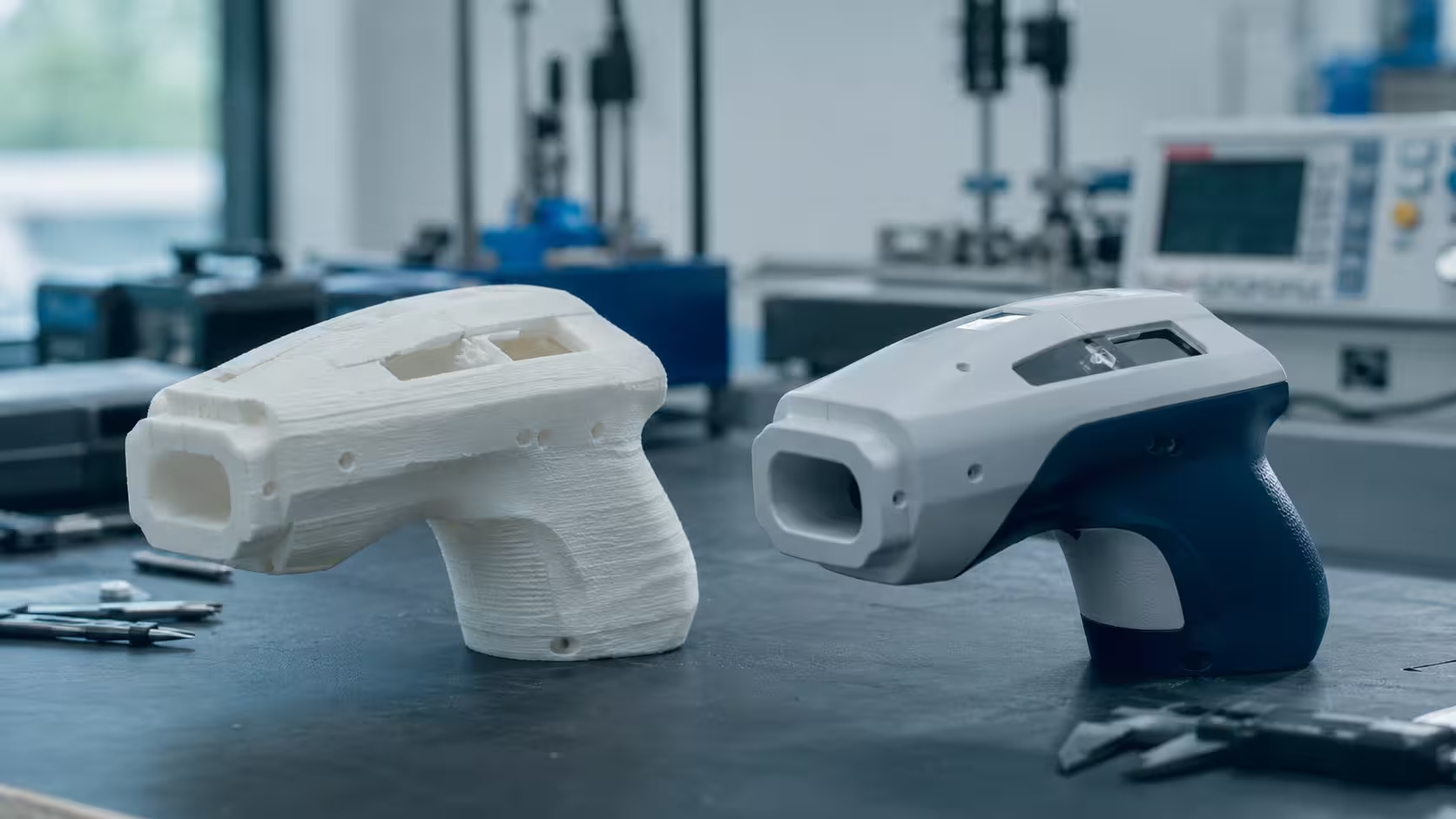
- Build prototypes and verify that design outputs meet defined inputs.
- Validate that the device meets user needs and intended use.
- Generate the required performance, pre-clinical, and clinical evidence.
- Prepare manufacturing processes, suppliers, packaging, sterilisation where applicable, and scale-up controls.
- Complete the relevant regulatory pathway.
- Launch with distribution, training, service, complaint, and post-market systems.
The exact activities and sequence vary with the device. A low-risk non-sterile product, an IVD, active diagnostic equipment, implant, and software-enabled device do not follow identical routes.
Risk Classification Shapes the Path
CDSCO describes India's risk-based device classes as Class A (low), Class B (low-moderate), Class C (moderate-high), and Class D (high).1 Classification is not a judgement of whether a product is “good” or “bad”; it helps determine the level of regulatory control appropriate to its risk.
Teams should use the current Medical Devices Rules, official classification notices and guidance, and qualified advice relevant to their product. Classification and intended use should be addressed early because they affect evidence, facilities, licensing, timelines, and cost.
Quality Connects the Lifecycle
Quality management is sometimes misunderstood as a set of documents produced near submission or audit. In practice, it is the system that helps an organisation translate needs into controlled requirements, manage risks and changes, verify and validate its design, control suppliers and manufacturing, maintain records, learn from complaints, and improve over time.
The Bureau of Indian Standards' overview of IS 23485 connects quality-management requirements with essential principles of safety and performance and refers to areas such as risk evaluation, clinical evaluation, biocompatibility, and software validation.2
This is why quality and regulatory specialists should work with technical and business teams from an early stage. Late discovery of an unsuitable material, missing design history, inadequate test method, uncontrolled supplier, or unsupported product claim can cause costly rework.
Evidence Must Match the Claim
The evidence required for a device depends on what the manufacturer says it does, where and by whom it will be used, the associated risks, and the target market.
Evidence may include engineering verification, safety and performance testing, usability work, software validation, biocompatibility, electrical safety, electromagnetic compatibility, package validation, sterilisation validation, stability or shelf-life work, pre-clinical evaluation, and clinical/performance evaluation. Not every item applies to every product.
The key principle is alignment: claims, risks, design, testing, evidence, labelling, and manufacturing controls should tell a coherent story.
Manufacturing Readiness Is Its Own Discipline
A prototype demonstrates a concept. A manufacturing system must reproduce a controlled product consistently.
Scale-up can introduce new materials, suppliers, tooling, tolerances, processes, software builds, packaging, or sterilisation conditions. These changes can affect safety and performance. Design transfer, supplier qualification, process validation, inspection, traceability, nonconformance handling, change control, and staff competence all become central.
Experienced manufacturers can therefore be valuable partners to startups and research teams. Their contribution is not simply factory space; it is knowledge of process capability, documentation, sourcing, yield, validation, quality control, serviceability, and scale.
Why Shared Facilities Matter
Specialised equipment and expertise can be difficult for one early-stage enterprise to finance. A Government of Kerala order on MedSpark describes proposed facilities for prototyping and pilot manufacturing, incubation, medical-device testing and evaluation, R&D/knowledge resources, and pre-clinical requirements.3
SCTIMST's medical-device engineering material also describes capabilities spanning design, modelling, fabrication, prototyping, evaluation, technology transfer, rapid prototyping, sterilisation, package validation, and material characterisation.4
Shared resources can shorten learning cycles and reduce duplicated investment when they provide:
- Clear scopes and access criteria.
- Competent technical support.
- Appropriate quality systems and accreditation.
- Transparent pricing and scheduling.
- Reports and data suitable for the intended regulatory purpose.
- Confidentiality and intellectual-property safeguards.
The existence of equipment alone is not enough; reliable service delivery is what creates industry value.
Commercial Scale Requires More Than Approval
Regulatory clearance or licensing is a critical milestone, but it is not the same as product adoption.
A company must still understand who buys and uses the product, how it fits clinical and procurement workflows, what evidence decision-makers expect, how it will be distributed, installed or trained, how service and spare parts will be handled, and how complaints and feedback will be managed.
For export markets, the company must choose destinations deliberately and plan for market-specific regulation, labelling, distribution, service, vigilance, and commercial conditions.
The Ecosystem Reduces Gaps Between Specialists
The Kerala Medical Technology Consortium describes the medical-technology lifecycle as too broad for any one entity to undertake alone and positions ecosystem connection as a way to support entrepreneurs across that journey.5
An effective ecosystem does not remove the manufacturer's responsibility. It makes the required capabilities easier to find and engage:
- Clinicians and users clarify needs and workflows.
- Researchers and engineers create and evaluate solutions.
- Quality and regulatory professionals shape a controlled path.
- Laboratories and specialist facilities generate appropriate data.
- Manufacturers create repeatable products.
- Suppliers provide controlled materials, components, and services.
- Investors and schemes may support viable development.
- Distributors and healthcare providers enable responsible adoption.
- Industry bodies identify shared barriers and represent collective priorities.
A Role for KMDIA
KMDIA can help make Kerala's development pathway more navigable by mapping capability, connecting members, sharing official information, organising practical learning, and representing common infrastructure and policy needs.
Its role is facilitative. The association should not promise regulatory decisions, certify products, select companies for funding, or substitute for qualified product-specific advice.
The most useful measure of success is whether more organisations make better decisions earlier: defining the right problem, planning the right evidence, building quality into development, finding capable partners, and preparing manufacturing and market systems before a launch deadline forces shortcuts.
From Invention to Dependable Care
MedTech innovation is not complete when a prototype works once. It succeeds when a device can be produced consistently, used safely and effectively, supported in the real world, and improved responsibly over time.
Kerala already has important pieces of that journey. A connected ecosystem—and an industry association able to articulate what companies need—can help those pieces work together more effectively.
Disclaimer
This article is a general educational overview, not product-specific legal, regulatory, clinical, quality, certification, or commercial advice. Requirements vary by device and market.
References
-
CDSCO, Medical Device & Diagnostics: https://www.cdsco.gov.in/opencms/opencms/en/Medical-Device-Diagnostics/Medical-Device-Diagnostics/ ↩
-
Bureau of Indian Standards, IS 23485 overview: https://www.bis.gov.in/bis-publishes-is-23485-medical-devices-quality-management-system-requirements-and-essential-principles-of-safety-performance-for-medical-devices/?lang=en ↩
-
Government of Kerala, G.O.(Rt) No.1192/2024/ID, 19 December 2024: https://document.kerala.gov.in/documents/governmentorders/govtorder2012202417%3A52%3A29.pdf ↩
-
SCTIMST, Department of Medical Devices Engineering: https://new1.sctimst.ac.in/about-sctimst/organisation/biomedical-technology-wing/department-of-medical-devices-engineering/ ↩
-
Kerala Medical Technology Consortium: https://kmtc.in/ ↩